






 Share
Share


— In CEMEA, Visa has seen growth in tokenised transactions from 26% in 2023 to 70% in 2026
— Since launch of stable coins settlement capabilities a year ago in CEMEA, settlement volumes have increased 60 times
AMMAN — Visa today outlined a series of AI, stable coin, and token capabilities designed to help clients across the Central and Eastern Europe, Middle East and Africa (CEMEA) region participate in the next generation of commerce.
Ahead of the Visa Payments Forum, Visa shared how two foundational shifts, artificial intelligence and stable coins, are transforming the front-end and back-end of commerce and money movement, and how Visa is enabling clients to adapt, scale and build trusted new experiences.
Regional President of CEMEA in Visa, Tareq Muhmood said, "Commerce is entering a new phase that is increasingly intelligent, programmable, and embedded into everyday experiences."
He added, "For companies serving the digital economy the opportunity is significant, but so is the need for trust and interoperability. Visa is focused on providing the infrastructure and intelligence to innovate confidently across the front-end and back-end of payments and deliver better experiences for the consumers and businesses they serve."
Powering Front End of Commerce with AI
Visa detailed how AI is reshaping how transactions are initiated, authorised, and trusted, while also accelerating how new commerce experiences are designed, developed and delivered.
As AI agents increasingly act on behalf of consumers and businesses, Visa Intelligent Commerce, the company’s platform for agentic commerce, provides the trust and controls needed for AI agents to securely discover, initiate and complete transactions.
To support this shift, Visa is working across the ecosystem to help ensure agent-initiated transactions are transparent and trusted.
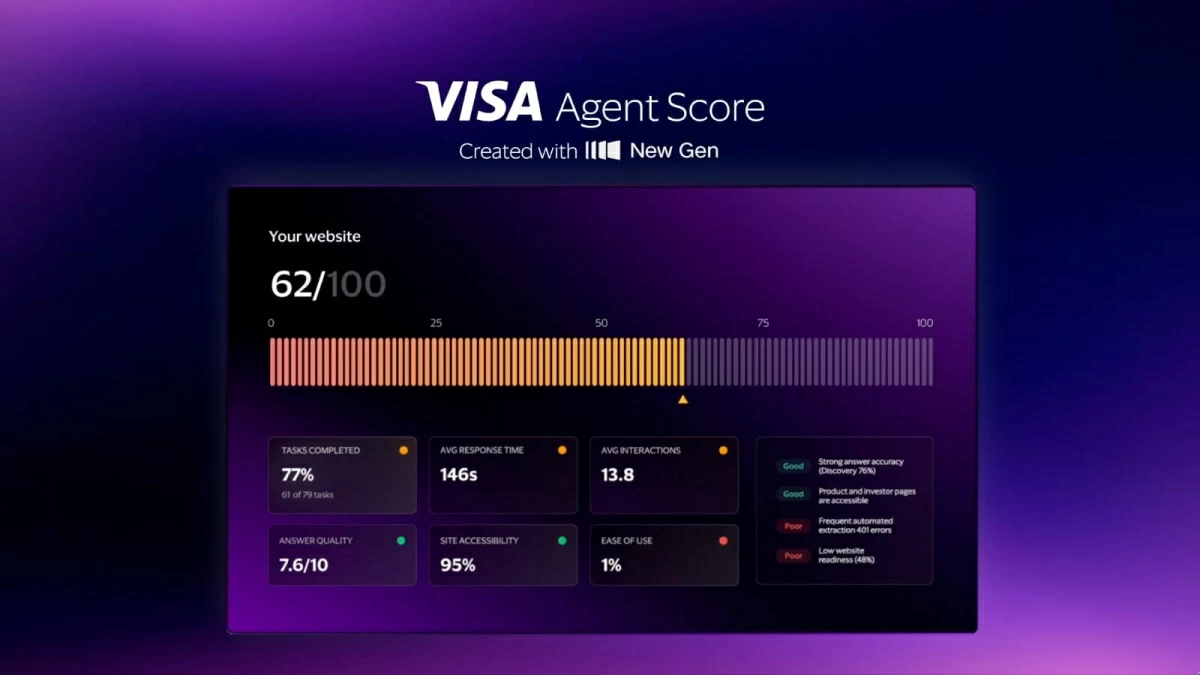
This includes merchant enablement through the newly launched Agent Score, created with New Generation, which allows merchants to evaluate their websites for agentic commerce readiness, specifically, whether AI agents can navigate, understand and complete tasks on a merchant’s website.
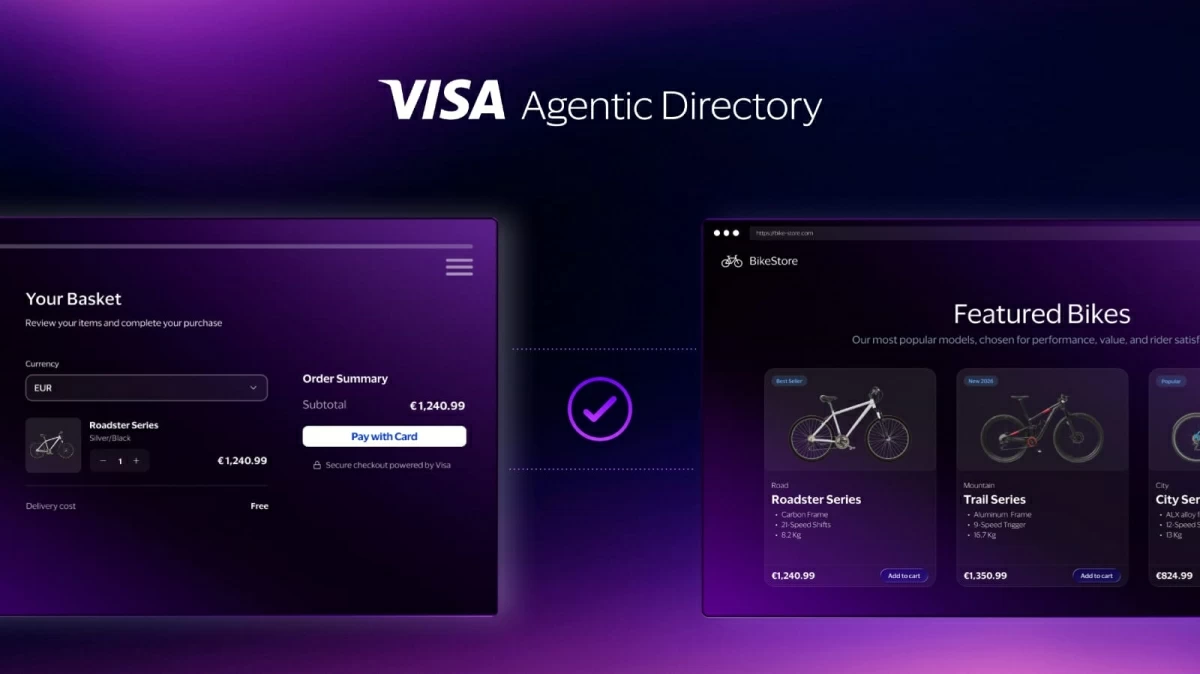
Merchants also need to know which agents can be trusted to transact on their sites, and agents need confidence that they are interacting with legitimate merchants.
With the launch of Agentic Directory, Visa is providing a directory that includes agents and merchants that have been verified as legitimate participants in agentic commerce.
Enhancing Tokens for AI-Driven Commerce
One of the key drivers of e-commerce growth in the CEMEA region has been the growth of tokenisation, bringing more secure, convenient and seamless payments to the region across e-commerce and mobile channels.
In CEMEA, Visa has seen a rapid increase in tokenised transactions, growing from 26 per cent in 2023 to 70 per cent in 2026.
Today, tokens already carry a highly secure data set purpose-built for digital payments. As commerce extends to new channels and agents, Visa is enriching the data to provide more details on the transaction type, where the token is being used and who is making the payment.
A second key advancement is a token assurance signal. Token use is evaluated throughout its lifecycle, based on provisioning and behavioural history, to generate a signal of trust behind each transaction.
Together, these advancements help strengthen the role of tokens as a foundation for trusted digital and AI-driven commerce, giving clients richer context and stronger assurance as transactions become more automated, embedded and intelligent.
Modernising back-end of money movement with stable coins
Visa shared progress in modernising settlement and value transfer through stable coins and block chain-based infrastructure.
With Tokenised Deposits, the company will build the technology layer that can allow banks to turn traditional deposits into programmable, always-on digital money. This gives banks a way to match the speed and flexibility of stable coins while keeping funds on balance sheet.
Visa is also expanding stable coin settlement pilots across multiple regions, block chains and currencies.
Building on its first stable coin settlement pilots in early 2025, Visa has moved billions of dollars in stable coins across VisaNet, with an annualised run rate of around $7 billion as of March 2026.
With issuing banks already settling seven days a week on chain with Visa, Visa is working to extend seven-day settlement to include acquirers, increasing flexibility and frequency across the entire ecosystem.
Since launch of stable coins settlement capabilities a year ago in CEMEA, settlement volumes have increased nearly 60 times.
To enable consumers and businesses to spend stable coin balances anywhere Visa is accepted, Visa continues to expand stable coin-linked card programmes.With more than 160 programmes live or in development globally, adoption is expected to accelerate.
Leveraging AI to turn insights into intelligence
To help clients respond to rising customer expectations, Visa is combining modern infrastructure with data-led capabilities that can support better decision-making across the payment journey.
The company is introducing an AI-powered travel intelligence capability that helps banks anticipate customer travel needs before a transaction occurs.
Launching today in CEMEA, Visa Trip Intelligence combines VisaNet intelligence with third-party data and can infer travel intent, generate personalised trip itineraries and provide activation-ready insights, enabling banks to deliver timely pre-travel support, reduce payment friction and offer more relevant benefits, services and experiences to customers while they travel.
Visa
Visa (NYSE: V) is a world leader in digital payments, facilitating transactions between consumers, merchants, financial institutions and government entities across more than 200 countries and territories.
Our mission is to connect the world through the most innovative, convenient, reliable and secure payments network, enabling individuals, businesses and economies to thrive.
We believe that economies that include everyone everywhere uplift everyone everywhere and see access as foundational to the future of money movement.
Learn more at Visa.com
